
Code the sound. Drive the world.
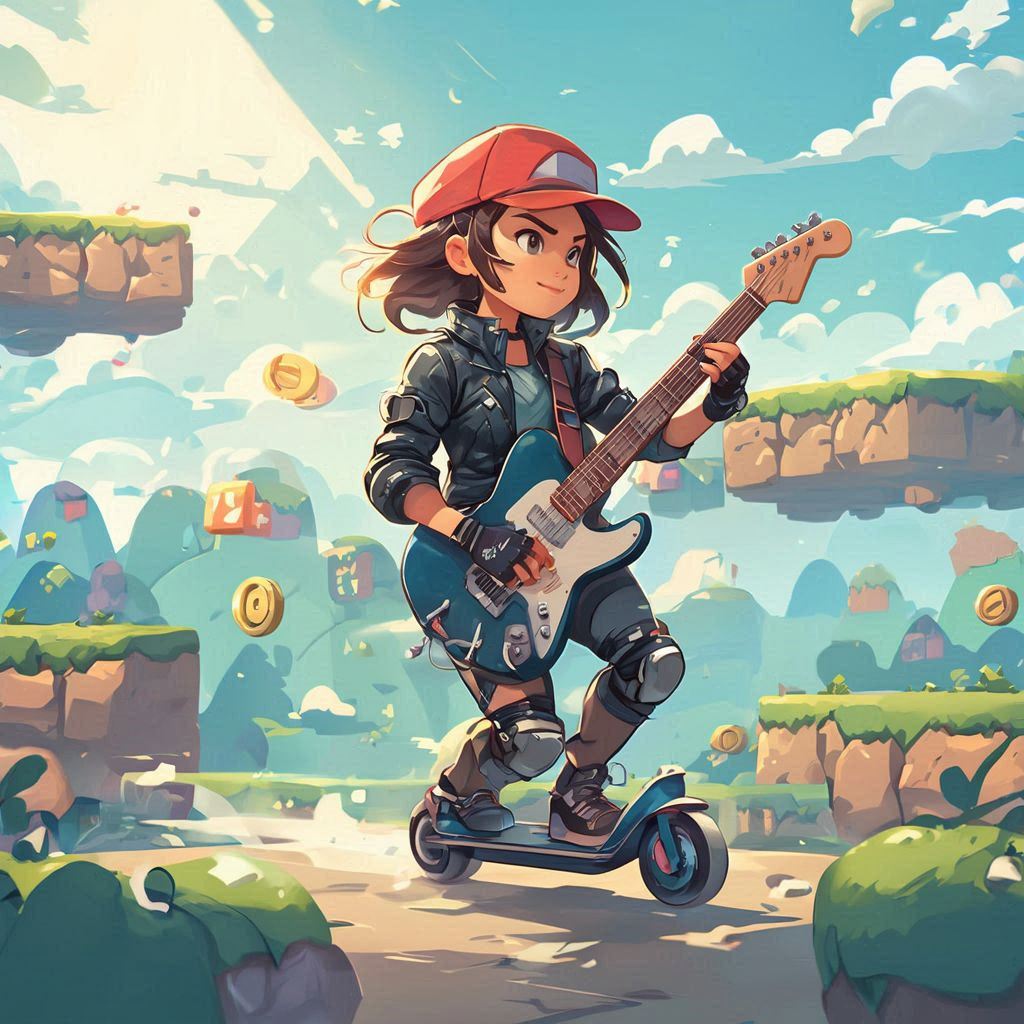
In an active imagination session, the scene began almost like a lucid blend of a concert and a racetrack. Two players stood side by side in a shared virtual space, each holding a guitar that felt both physical and symbolic—lightweight in the hands, yet responsive in a way that demanded full attention. Ahead of them stretched a glowing racecourse that pulsed in rhythm with a backing track. The finish line was visible, but not fixed; it seemed to shift in distance depending on how well each player performed.
As the first sequence began, notes appeared as flowing patterns along the track. Each player had to strum and fret in time, learning chords in real time while simultaneously trying to maintain forward momentum. When one player hit a chord cleanly, their vehicle surged forward with smooth acceleration. When the other missed a transition, their pace faltered briefly, forcing them to recover not just musically, but competitively. What emerged was not just a race, but a dialogue between learning and performance—mistakes slowed both progress and music, while precision created a sense of effortless motion.
The experience quickly shifted from novelty to something more meaningful. Instead of learning guitar as a separate, isolated skill, the act of playing became inseparable from movement, focus, and emotional engagement. The competitive element didn’t distract from learning—it reinforced it. Each repetition of a chord progression had stakes, but also immediate feedback that was both auditory and physical. Improvement wasn’t abstract; it was felt as smoother acceleration, tighter control, and clearer sound.
From this imagined experience, the concept naturally expanded: a virtual reality system where learning an instrument is not confined to practice rooms or static lessons, but embedded in interactive worlds where skill translates into action. A person of any age could enter, choose an instrument, and immediately experience both guidance and gameplay. It reframes music education as something alive and participatory—where mastery is not only heard, but seen and experienced through motion, challenge, and play.
This specification is released under the GNU Affero General Public License v3.0 or later (AGPL-3.0+) and may be used freely with required attribution under Section 7. A Specification Branding License is available for attribution-free deployments, with fees based on usage, scope, and deployment size.
Specification Repository:
- HarmoniX Drive – Open-source VR music racing platform where musical precision drives real-time speed and performance.
Specification Pricing:
| Network Size | # of Users | One-Time Price | Duration |
| Small | 1 – 20 | Custom Quote | Perpetual License |
| Medium | 21- 1000 | Custom Quote | Perpetual License |
| Large | 1001 + | Custom Quote | Custom Quote |
