
Navigation. Awareness. Freedom.
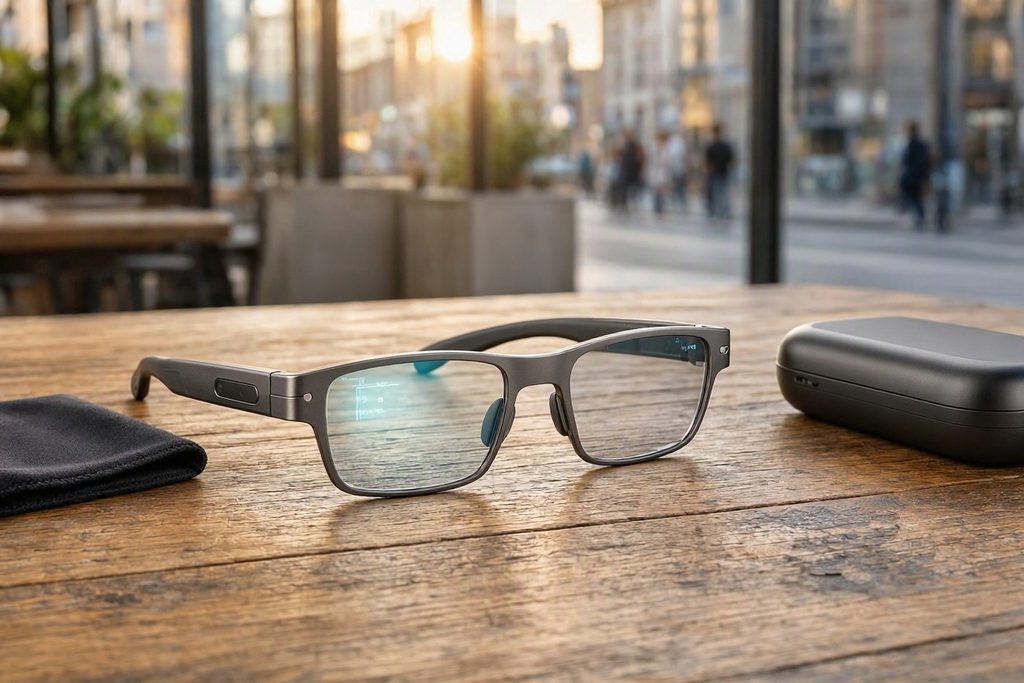
SenseAR is an intelligent, AI-powered smart glasses and environmental awareness platform designed to transform how people interact with and navigate the world around them. Inspired by the advanced perception technologies used in autonomous driving vehicles, SenseAR combines computer vision, artificial intelligence, spatial awareness, depth sensing, and real-time sensor fusion to interpret the surrounding environment. Its primary mission is to empower people, particularly those who are blind or visually impaired, with greater independence through continuous environmental understanding and intelligent, hands-free assistance.
At the heart of SenseAR is an advanced environmental perception engine capable of recognizing and interpreting objects, people, vehicles, buildings, signs, obstacles, and other surroundings in real time. Rather than simply identifying what a camera sees, SenseAR analyzes spatial relationships, estimates distances, tracks movement, and provides contextual descriptions through natural voice guidance. Users can receive continuous play-by-play explanations of their surroundings, ask questions about nearby objects, read signs and printed materials, identify landmarks, and obtain useful information through conversational AI. Audio guidance can be personalized to deliver concise notifications or more detailed environmental descriptions depending on user preferences.
SenseAR extends beyond visual recognition with intelligent navigation, spatial mapping, and predictive hazard detection. Using multiple cameras, depth sensors, optional LiDAR, GPS, inertial measurement units, and autonomous-driving-inspired perception algorithms, the platform builds a dynamic understanding of the user’s surroundings. Its capabilities include detecting approaching vehicles, recognizing intersections and crosswalks, identifying stairs, curbs, uneven surfaces, and obstacles, tracking moving objects, and assessing potential collision risks. Indoor and outdoor navigation provide directional guidance, route planning, landmark recognition, and obstacle-aware recommendations, while contextual intelligence helps prioritize important information and communicate environmental changes before they become immediate concerns.
Designed around a modular and extensible architecture, SenseAR will support interchangeable hardware, independently configurable AI capabilities, and optional plugins that expand its functionality. Additional capabilities can include public transportation awareness, retail and product recognition, document reading, conversational assistance, spatial audio, emergency notifications, and personalized accessibility settings. Local AI processing, privacy controls, and hardware flexibility will help make the platform adaptable to different environments and user requirements. Ultimately, SenseAR aims to become an intelligent wearable companion that provides a continuous understanding of the world, helping people navigate unfamiliar environments, recognize potential dangers, interact with their surroundings, and experience greater confidence, independence, and freedom.
This specification is released under the AGPL-3.0+ and is free to use with required Section 7 attribution. Organizations seeking attribution-free deployment may obtain a Specification Branding License, with fees based on use and deployment scope.
Specification Repository:
- SenseAR – An open-source AI-powered smart glasses platform that delivers real-time environmental awareness, intelligent navigation, predictive hazard detection, and contextual audio guidance to promote greater independence and accessibility.
- HTML Mirror: SenseAR Specification
Specification Pricing:
| Network Size | # of Users | One-Time Price | Duration |
| Small | 1 – 20 | $500,000 | Perpetual License |
| Medium | 21- 1000 | $10,000,000 | Perpetual License |
| Large | 1001 + | Custom Quote | Custom Quote |