
Turning Appliance Engineering Into an Open-Source Ecosystem.
The Universal Appliance Standard (UAS) is an open-source engineering specification designed to transform appliance development from a collection of proprietary, closed products into a shared, modular engineering ecosystem. Its goal is to establish a common foundation for designing refrigerators, freezers, ovens, dishwashers, washers, dryers, HVAC systems, water heaters, and future appliances. Each appliance exists as its own expandable module while sharing common standards for mechanical interfaces, CAD, materials, energy systems, manufacturing, testing, repair, and documentation.
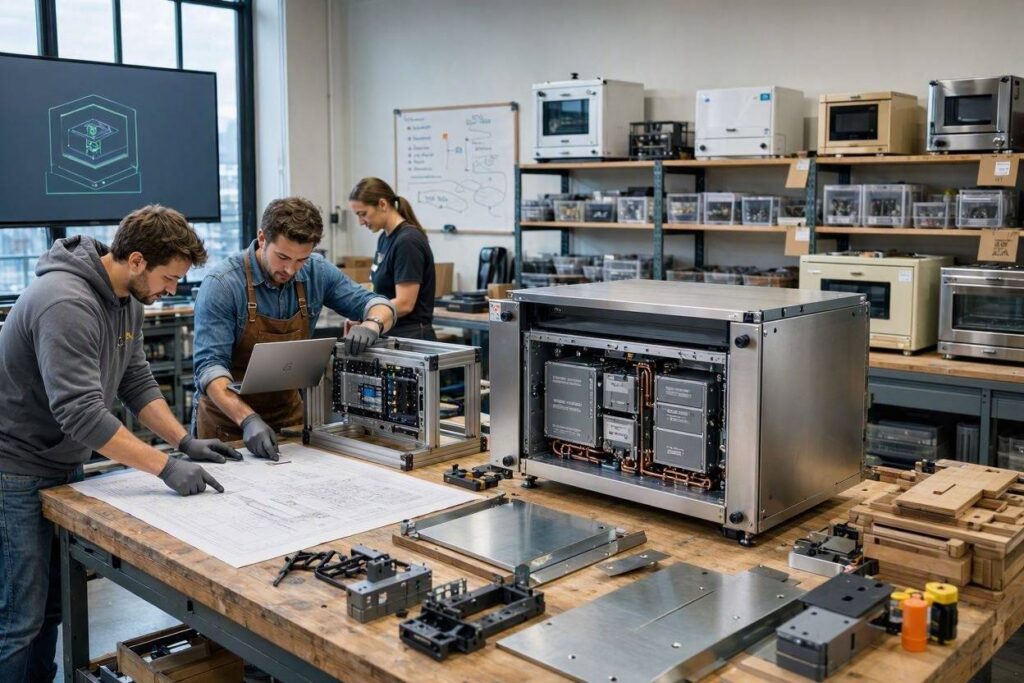
A defining feature of UAS is its virtual-first, CAD-first approach. Appliances are designed digitally before physical production whenever practical, with complete 3D models, mechanical drawings, component specifications, simulations, bills of materials, manufacturing requirements, service documentation, and testing methods. Modular construction allows individual parts and systems to be customized, replaced, repaired, or upgraded without requiring the entire appliance to be discarded. Optional plugin modules can introduce advanced materials, thermal technologies, smart controls, energy optimization, diagnostics, and other capabilities without changing the core appliance architecture.
UAS also places materials innovation and energy efficiency at the center of appliance engineering. Designs can evaluate new lightweight, durable, water-resistant, recyclable, and energy-efficient materials as they become available rather than remaining locked to today’s manufacturing assumptions. Energy performance can be modeled across the complete appliance, including insulation, motors, compressors, heat exchangers, controls, thermal losses, and operating conditions.
Another major feature is the AI-assisted engineering and manufacturing system. AI tools can help identify suitable materials and components, compare suppliers, locate manufacturers capable of producing individual parts, determine where assemblies can be completed, and identify local or regional manufacturing capabilities. The system can effectively work backward from the digital design to create a manufacturing map: what needs to be made, how it can be made, where it can be made, where it can be assembled, and how it should be tested.
The standard also emphasizes repairability, supply-chain resilience, and continuous improvement. Components are intended to use documented interfaces and, where practical, multiple suppliers and compatible alternatives. Testing procedures, engineering methods, references, sources, CAD, mechanical documentation, and manufacturing information are part of the engineering record rather than being treated as proprietary knowledge. This creates a foundation where an appliance can be manufactured locally, repaired throughout its service life, upgraded with future technology, and improved by contributors across the open-source ecosystem.
Specification Repository:
- Universal Appliance Standard – An open-source framework for designing modular, customizable, energy-efficient appliances with CAD, AI-assisted sourcing, local manufacturing, repairability, testing, and continuous innovation.
Specification Pricing:
| Network Size | # of Users | One-Time Price | Duration |
| Small | 1 – 20 | $200,000 | Perpetual License |
| Medium | 21- 1000 | $500,000 | Perpetual License |
| Large | 1001 + | Custom Quote | Custom Quote |
